Showing posts with label Robin Ince. Show all posts

Sunday, 25 October 2015

Every 14 Days...(29)

Ring/Spiral/Loop (Koji Suzuki)

Recently, there's been a lot of talk among the film festival circuit of Hideo Nakata's new release 'Ghost Theatre', after years of not really being talked about. Completely coincidentally, I decided to re-read the 'Ringu' trilogy (well, re-read two-thirds; read for the first time one-third) that inspired the film that shot not only him, but many other 'Asia Extreme' directors to international fame.
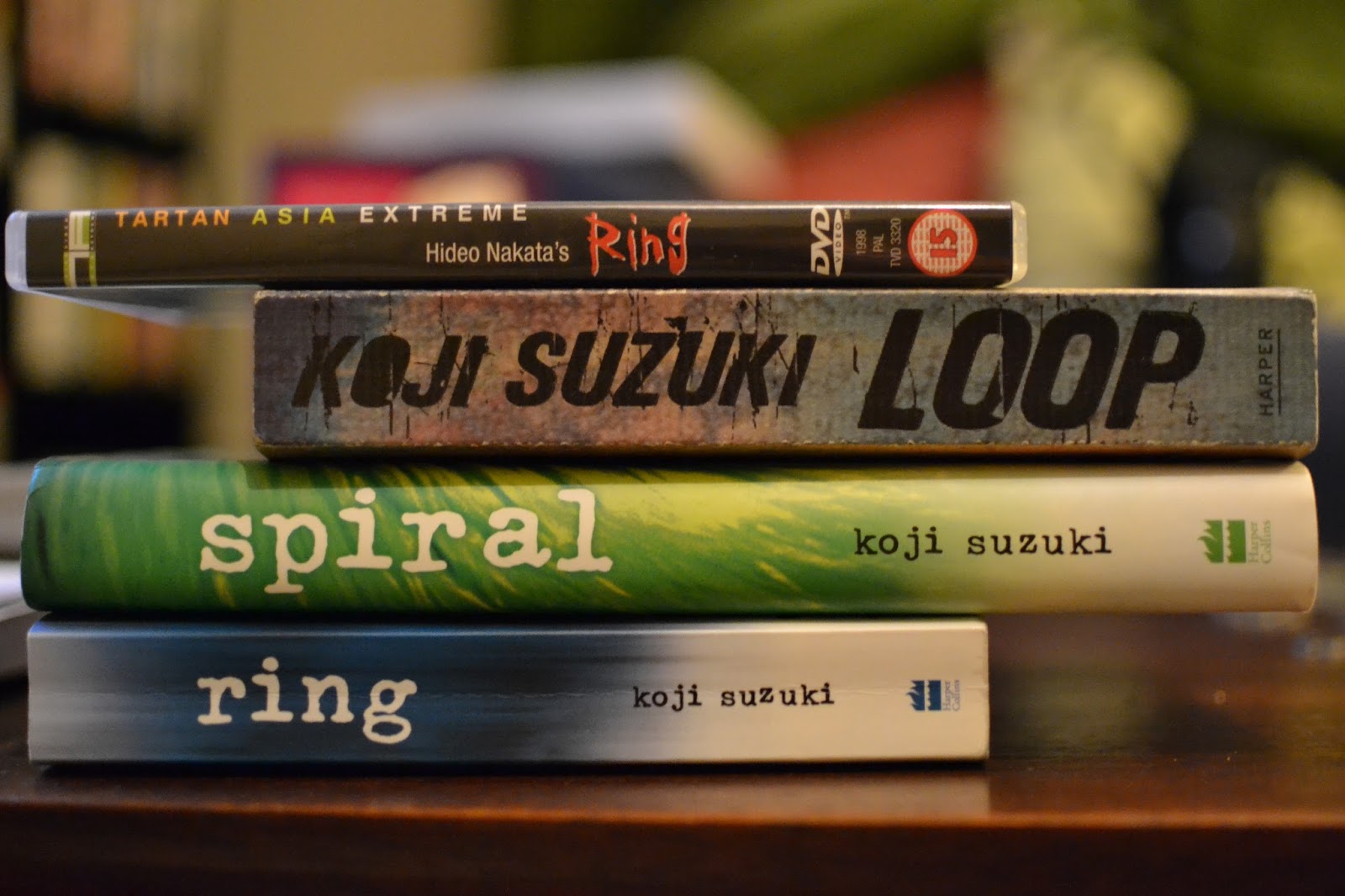

'Ring' is an interesting one in the 'book vs. film debate,' with the majority of people typically claiming the book is better to give the vain veneer of being mildly intellectual (larks!). For me the film overshadows the book that gave birth to it. Nakata changed certain elements for the film version: changing the lead to a female, stating that females are more believable in being frightened; the very cinematic ending, that probably wouldn't have worked in book form. These changes improve Koji Suzuki's story, removing some of the stranger elements towards the first book's conclusion that spawn into the sequels.

'Ring', the first book in the trilogy is by far the strongest piece, starting with a detailed discovery by journalist Asakawa that his niece's mysterious and sudden death is linked to three others that happened at the exact same time. Investigating this lead, he visits the Villa Log Cabin where the four dead youths stayed a week before their deaths. There he finds a strange video that will change his life, for seven days, at least.

The idea and the story is a good one, and perhaps a 1990 satire on modern media leaving us all brain dead, who knows?! Enlisting the help of his friend, Ryuji, he searches for an answer to the 'charm' (it is continually referred to as) to lift the video's curse, and thus not die in seven day's time.

Much like the film, however, the two sequels are where things start to go wrong. 'Spiral' takes the theme to a new character, Ando, a doctor that carried out an autopsy on *spoiler-alert* Ryuiji's body. Ando, for some reason, seems to believe that Ryuji is trying to leave him a message in his DNA structure, using random code-breaking techniques from his college days to form a rather unlikely, and largely meaningless, message. This leads Ando to go through the same journey as Asakawa, only with less information, with DNA investigations, re-births and the 'virus' switching to book form following.

The third in the trilogy, that I hadn't previously read, 'Loop' gets even more far-fetched, with third main character, Kaoru, a student doctor, using some random thing he looked at as a child to try and solve the mystery of the new cancerous virus that is spreading across the world.   

I first read 'Ring' and 'Spiral' when I was a student, a good decade ago, when I was definitely less well-read. One problem of being slightly more well-read is that I have recently read 'Robin Ince's Bad Book Club', particularly the thrillers chapter. Ince's description of thrillers is that they are overly long, filled with unnecessary descriptions of clothing and naked breasts, designed more to just keep the reader amused rather than provoke thought. They are simply written, with everything explained, re-explained and again, to make a lengthy book to justify your buying it. All three of these books are long, particularly 'Loop', and - while this may be due to the translation - are quite simply written, particularly 'Loop'. 'Spiral' features an entire chapter that summarises 'Ring', and 'Loop' in turn has chapter dedicated to summarising 'Ring' and 'Spiral', as you go round-and-round - how possibly intentional?!

I enjoyed 'Ring', was less enthused by 'Spiral', and was just bored by 'Loop'. Things are just taken a bit too far here and it becomes a little over-indulgent. The 'Ringu' trilogy is about a video that spawned a book that lead to a major virus. The reality is that this was a book that spawned a film that spawned a DVD empire in the West, that lead to endless over-indulgent copy-cats, that quickly saw companies fold.

As with the first book, 'Ring', making copies only leads to problems, and turning a good book into a trilogy only serves to spoil the original. It should probably have just been left at that.

Ring
Days to read: 18
Days per book: 14.7

Spiral
Days to read: 14
Days per book: 14.7

Loop
Days to read: 15
Days per book: 14.7   

Saturday, 5 September 2015

Every 14 Days...(28)


The Bluest Eye (Toni Morrison)

My introduction to Toni Morrison's first novel, 'The Bluest Eye', was via the unlikely source of the liner notes of hip hop album. But hip hop ain't all ig'nant sheeeeet, with the more thoughtful 'Mos Def and Talib Kweli are Black Star' album featuring the track 'Thieves in the Night', with its hock borrowing heavily from one of the novel's closing passages.

I first read this as a suitably foolish twenty-one-year-old, largely in Newcastle's Heaton Park, and probably then I didn't quite grasp the power of the book. So now, reading it a decade later, did it register a little more?

The answer is yes. As a woman narrates, reminiscing on her childhood in 1940s America, the book explores race, the concept of beauty and the evils of modern communities when looking down on those they deem below them.

The story is fractured, splitting between the narrator's story, the past events that worked towards creating that time and a picture of an 'ideal' family. As the story continues, earlier passages become more powerful as their meaning becomes more and more clear.

Despite her own criticism of the work, it is elegantly written, reading with a flow that could inspire any hip hop, worth every moment of its second listen.

Days to read: 12
Days per book: 14.8


Robin Ince's Bad Book Club (Robin Ince)

When it comes to films, it's not the awful, 1-star films that should never have been made, it's those non-descript, neither good nor terrible, unmemorable, mind-numbingly average films that should never have been made. Most films starring Vince Vaughn, perhaps. If you know something isn't going to be a critical success, you may as well make it awful; it's more purposeful that way.

When it comes to books, in comes Robin Ince. Beautifully angry Ince had toured his 'Bad Book Club', reading aloud on stage from those books that should never been written - but deliciously, that is the very reason why they should exist. Setting himself the task of only reading books purchased second hand from charity shops and second hand bookshops while bored on tour for a price of under £3, this book - which category it fits in, you decide - is a summary of some of his favourite awful books.

Split into sections, Ince forces his way through biographies, Mills & Boon, thrillers, self-help guides, horror, religion, journalist collections and more, all finding themselves deemed necessarily awful. Quoting passages, there are moments of hysterics as you question why anyone would ever want to read it, or indeed ever sit down to write it.

So much terrible material can, of course, drag a little when reading, and there are moments when the reader can find themselves drifting in and out of concentration. Though you have to commend Ince's dedication to unearthing pure nuggets of fake gold descriptions of women's breasts, painful Syd Little anecdotes and the dietary requirements of Jesus. 

We'd all like to think that we're intelligent consumers of high art that many cannot understand, but there is something wonderful about the completely awful and what it tells us about humanity.

Toilet book? It certainly is full of shit.

Days to read: 18
Days per book: 14.8


Hear the Wind Sing / Pinball, 1973 (Haruki Murakami)

I'd already read all of Murakami's books, by which I mean, of course, I hadn't - I'd read all of his books that someone had bothered to translate into English. I'd seen academic English translations of his first two novellas, though being academic texts, they cost more than any student could afford, so I thought better of it.

But now, given his popularity in the West, someone has finally bothered to mass produce translated versions of his works he wrote while a Tokyo jazz bar owner - because no one really wants to read anything by a Japanese amateur unless they go on to have two and a half decade's worth of success.

So, what of these first two works by the young amateur? Well, not a huge amount really; very much what you'd expect from a young amateur. These are essentially two stories around the same characters at two points in time. Little really happens other than drinking in bars, buying records and playing pinball. You wouldn't be missing a great deal if these were never translated.

What you do get, however, is a sense of his style developing that he has maintained throughout his whole career. The characters are young - sometimes students - men unsure of their direction in life, spending their days in bars and beds, all to the accompaniment of specific music descriptions. The switching between narratives he most famously used in 'Kafka on the Shore' is also present in an early form.

Probably one (of two) more for the hardcore fans this. I can now actually say I have read all of his works, though I probably haven't learnt a great deal more as a result, apart from his introduction giving a little more detail as to why he first started writing: baseball is the answer we all knew it would be.

Hear the Wind Sing
Days to read: 6
Days per book: 14.8

Pinball, 1973
Days to read: 7
Days per book: 14.7

Sunday, 15 March 2015

Every 14 Days...(25)

It's the Christmas Special...in mid-March!

Christmas Special obviously referring to this edition covering the books I received as Christmas presents last year. And seeing as I can't read five books in one day - though that would have an amazing impact on my days per book rate - this Christmas Special arrives in Spring.


Dead Funny: Horror Stories by Comedians (Edited by Robin Ince and Johnny Mains)

'Dead Funny' comes from the theory that good horror always comes with a generous helping of black humour. What can only be described as a charity gig of British comedians has, therefore, been assembled, each tasked to write a short horror story that will have us screaming with both laughter and terror. This of course doesn't really happen.

The sixteen stories can be categorised into one of three groups: the silly comedy, aiming more for laughs than scares (Reece Shearsmith, Richard Herring, Michael Legge, Danielle Wheeler); the psychological black humour (Stewart lee, Phill Jupitus, Rufus Hound, Robin Ince, Al Murray); and the greater attempts at horror writing (Mitch Benn, Matthew Holness, Neil Edmond). There are then those that just don't fit the horror or humour categories, largely due to my lack of respect for the comedian.

As with any short story collection, the level of quality varies throughout, ranging from the very strong to those that can just be glossed over and forgotten. Notable mentions go to Stewart Lee's 'A View from a Hill' blurring the lines between reality and fiction to mess with his audience's minds, as ever, and Mitch Benn's 'The Patient'.

There are obviously more laughs on offer here, and some maybe show that writing fiction isn't their strong point, with some stories falling off by the end. But that's not why this was bought for me - it was to make me laugh, which it did. LOOOOOOOOOOOOOOOOOL (in a ghost voice).

Days to read: 14
Days per book: 15.0


Thinking About it Only Makes it Worse (David Mitchell)

No, not that one. This David Mitchell likes a good moan, and this is a book full of his moanings that he writes for the Observer. 'Tis quite the standard for comedians these days to publish books of their collected ramblings for whichever broadsheet they write.

Often, these are entertaining, short nuggets of thought from comedic minds. Though coming from a collection of years worth of writing, they can be sometimes inconsistent and ask you to think back to that time when the horse meat scandal was all the news knew existed.

I've always subscribed to the thought of Mr Mitchell, and this book is no different, providing wit, insight and moments of outrageous cynicism to entertain. This probably didn't tickle me quite as much as his holiday chum Charlie Brooker's books - though this didn't come with free tickling gloves - but still raises a smile with thoughts that make things better.

Days to read: 20
Days per book: 15.0


Captain of Hungary (Ferenc Puskas)

It's hard to believe, but 1950s Hungary was the Premier League hair salon of its day. The 'Magnificent Magyars' as they were dubbed were the international team to beat (if you're West German), with an unbeaten run that stretched forever and a day, as they proved the greatest team never to win the World Cup...after the England team featuring Danny Mills, of course.

It was common for members of the squad to release an autobiography in their mid-twenties, cashing-in on their fame, much like even the least interesting Premier League (non) star will do today. What's probably different here, however, is that this book is about football. Strange to think that, an autobiography by a football player at the height of his fame, but it is. Very little is about off field activities, with focus largely on his skill and how amazing a talent he was, and how the opposition's style of play led to their defeat. There are chapters dedicated to single games, namely their defeat of England at Wembley and the 1954 World Cup final.

This book is only part of the story, his days playing in Hungary when he was part of the best international team around. This is the days before his move to Real Madrid and the success that followed there.

A man that now has the FIFA goal of the year competition named after him, there's no doubt that he was good. And Puskas definitely alludes to this writing with an arrogance/knowledge of his own ability. Written approximately sixty years ago, it shows that the more things change, the more they stay the same.

Days to read: 8
Days per book: 14.9


Ayoade on Ayoade: A Cinematic Odyssey (Richard Ayoade)

Hello, my name is Withheld and I've never seen a film directed by Richard Ayoade. That's not exactly many, but I do feel it still qualifies me to read a book he has written about film making. But this isn't exactly a normal film book about normal films.

'Ayoade on Ayoade' is a supposed collection of interviews between Ayoade and an alter-ego Ayoade about film. But, if his interview with Krishnan Guru-Murphy on Channel 4 News is anything to go by, he doesn't exactly do interviews.

What this becomes, therefore, is a random collection of obscure thoughts that always trail off, full of sarcasm and post-irony. It's clear that Ayoade is being subversive here, discussing bad Eighties films and obscure references to Nineties music that teach us little about his real thoughts on directing.

But within this there is a clear lampooning of the film industry and the character types that inhabit it, hiding what his thoughts on good filmmaking are behind mocking of bad.

Or have I just made all this up?!

All-in-all, I'll give this twenty-seven thumbs up on a scale from one unspecified number to another.

Days to read: 13
Days per book: 14.9


For Richer, For Poorer: Confessions of a Player (Victoria Coren)

Having read her husband's new book, I had show that I believe in equality and read Victoria Coren-Mitchell's (then just Victoria Coren) book about her life and times as a millionairess poker player.  

Now, I don't really play poker, never in fact, and so this book is of little interest to me. But being that 'Only Connect' is the best show in television, I simply had to read it.

As expected from the lady herself, it is a book full of wit and charm, charting her rise from chubby teenager joining in her brother's poker games to European Poker Champion, winning a fair amount of money along the way. Being that this is about the world of poker, a lot is lost on me or in language I don't understand, so parts drag or seem a little repetitive, when they probably are anything but. For much of this she is as much observer than player, focusing on the characters, personalities and superstars that the 'sport' has created, herself a lowly player who used her comedy and journalistic skills to become a celebrity poker player.

The book builds to her European success, as her playing career progresses, though now poker celebrity is just one of the many hats she wears, big Stetsons, of course.

Days to read: 18
Days per book: 14.9 

Tuesday, 11 January 2011

From a Previous Life...Comic Relief (18/04/07)

Originally written: 18/04/2007

With so many comedians tripping off to Africa, or another part of the world, in an attempt to cure world poverty, it would appear that they've forgotten to take care of their own.

Only last Saturday, I was sat outside the Alwyn near Highbury Corner, when noneotherthan Alan Davis sat at the table beside me. But sadly, it would appear that years of ridicule from Stephen Fry on QI have taken their toll, as a hungry-looking Davis eyed-up my burger, licking his lips in lust. With his now greying, curly locks and look of weariness in his eyes, he looked a shadow of a man we know as Johnathan Creek.

It then occurred to me that only weeks before, I saw an also greying and dishevelled-looking Robin Ince hurrying and rushing up Great Portland Street on his way to one of his gigs. Obviously years as Ricky Gervas' warm-up have left their mark on the stress-filled life of Mr. Ince.

I, therefore, believe that we should take a minute out whenever we see one of our beloved comedians and go to the trouble of buying them a burger to stop this terrible tragedy from becoming more serious. If we don't, what is to happen next? Craig Charles smoking crack in the back of a taxi? Who knows?

I think we all know the world would be a much better place if our comedians are well-fed and have the opportunity to work in a stress-free environment, away from the torment of their comedy seniors...

Kick Wise people...