Wednesday, 10 February 2016

IKIRU: The highs and lows of life in Japanese cinema

London, late-January/early February sort of time, and e Japan Foundation presents its annual Touring Film Programme, starting off at the ICA and moving to the more artistic cinemas in various cities up and down the UK. And every year there must be a theme.

This year's theme is quite a good one: Ikiru, the Japanese verb 'to live', and the name of a famous Akira Kurosawa film (no, not 'Throne of Blood' fans of Stewart Lee's Comedy vehicle Series 3'). In Japanese cinema, this is a genre - if you'd call it that - of cinema typically associated with Yasujiro Ozu and his portraits of change in ordinary, everyday Japanese life; a theme carried on into the new millennium by Kore-eda Hirokazu.

Far from grand samurai classics and out-of-this-world anime, these are slower films, films to provoke more introspection, films to make you laugh and cry, and then vomit while reading this. This, the thirteenth JFTFP (JFTFP!), saw me see fewer films than I typically would, driven largely by busy-ness, seeing Tony Law and not wanting to watch four straight films on a Saturday, especially as Villa had won for once, so I had to watch Match of the Day.

In the words of Scha Dara Parr, let it flow, again...


Cheers from Heaven (Tengoku kara no eru; 天国からのエー)

'Cheers from Heaven' is probably a bit mainstream for me; it's a fair example of low-level mainstream cinema that's decent, not amazing, forcing emotions on its viewers with a tad too much sentimentality. Saying that though, I had to see this one of all the films shown as part of this year's programme.


In a small Okinawan town, a group of not-particularly-musically talented school children struggle to find anywhere to practice their not-particularly-impressive talents. Annoying adults, local bento supplier, Hikaru, disillusioned by a lack of community spirit, takes the group of children in, allowing them to play in a spare area behind his kitchen. But being essentially open-air, this doesn't really solve the problem. But, never one to give up easily, he takes it upon himself to start building a studio for the children to use freely (in each sense), but as long as a community of sharing is followed.

The kids delight in this, and suddenly every child in the town has a guitar and comes knocking on the door. But Hikaru's focus stays on the original group he took in, becoming a manager of sorts in helping them pursue their dream, for reasons that become quite sentimentally apparent. In true light movie fashion, they succeed.

The content meant little to me, however. 'Cheers from Heaven' is set and filmed in the northern Okinawan town of Motobu, where my wife and I stayed as part of our honeymoon. The real life Ajisai studio, opened by once real life man Hikaru Nakasone, was on the winding hill path that we walked passed each day en route to our guesthouse. For the majority of the film, therefore, I was sat looking at the scenery and remembering what I did there, such as the public lavatory I once stood outside, where the headline act's drummer and guitarist have a fight.

Famous Motobu toilet
The 'living' element of this film is a tale of a man perhaps a little fed-up with how things have become, in his own life and society in general, feeling the need to make some sort of change and realise a dream, before it's all tragically too late, if a little forced by the conclusion.

This is a nice film, a steady film, a decent film that perhaps needs to stop trying so hard by then end to get its message across. But for me, it probably serves more as a holiday memory.


I'll Give it My All, Tomorrow (Ore wa mada honki dashitenai dake; 俺はまだ本気出してないだ)

'I'll Give it My All, Tomorrow' is a title I liked the moment I read it, particularly as it came accompanied by a photo of a man in boxer shorts. It's fair to say, this is my kind of comedy.
In his forties, Shizuo gives up his salaryman job to work part-time in a fast food bar and sitting about playing an 'important match' of his Playstation. Living with his father and seventeen year-old daughter, his slack attitude soon frustrates his family and Bob, the foreign employee in the fast food bar. See as a superior by those younger than him, but a waste by those by those who depend on him, he soon makes it his life ambition to become a manga artist...at some point, some time.

This is a film about the life that happens when you're making plans, too busy sitting about and thinking about what you should do rather than getting anything done. While the earnest desire is there, the proactive motivation is somewhat lacking, resulting in a limbo. A mid-life crisis finds your average salaryman working alongside and socialising with young adults still trying to find their place in the world, naturally to the amusement of the likes of me.


'I'll Give it My All...' captures well that somewhat naive compulsion that men have to pack it all in, fight the system and sit in their pants playing Playstation while the rest of society moves on; the freedom we all want, but is probably quite dangerous in misguided and confused hands.

Shinich Tsutsumi is well cast as the anti-hero, seemingly confident to those his junior, but unable to achieve and get his life moving, and Yuichi Fukuda's direction works well in magnifying his shortcomings, as a forty-two year old man asks his seventeen year-old daughter to lend him twenty thousand Yen.


If you too would like to learn about how mundane your life is, the Japan Foundation Touring Film Programme travels to the likes of Leicester, Bristol, Birmingham, Derby, Sheffield, Aberystwyth, Dundee, Edinburgh, Kendal, Exeter, Nottingham and Manchester...though you're probably already aware of said fact.  

Sunday, 31 January 2016

Grand Form - P&M Remix (Punch and Mighty Feat TAKE-T)

First video for a while. Punch and Might's P&M Remix of 'Grand Form' featuring TAKE-T (incorporating Crooklyn Dodgers' 'Crooklyn') to some lovely honeymoon snaps from Kansai, Ryukyu and beyond (i.e. Kyoto, Kinosaki, Naha, Motobu, Ishigaki, Taketomijima, Osaka, Koyasan)...

Sunday, 3 January 2016

Every 14 Days...(30)

Through no clever intention on my part, I have recently read three biographies by comedians. However, to call these autobiographies might be a little confusing. What follows is a selection of works by British men of the funny, but either written by or from the perspective of an alter ego. Much as Stewart lee will refer to the ‘character Stewart Lee,’ here we see a collection of comedians showing their schizophrenic sides. Comedia schizophrenia, as it were.


Me:Moir (Vic Reeves/Jim Moir)

To start, we see beloved funny man Vic Reeves writing on the childhood upbringing of James Moir, or ‘Rod’ (his middle name) as he was known to his family. That’s a confusing start.

Here, the fictional Mr. Reeves describes the first eighteen-or-so years of his life from his first days in Yorkshire, to County, to eventually moving down to London to start his journey to adulthood. Accompanied by his own doodles throughout, there are elements of Reeves' trademark eccentric humour throughout, though it's difficult to say if these were early seeds or embellishment by his adult self.

This is a steady effort, but nothing too sensational. Focusing more on his youth, this doesn't go into the origins of his 'Big Night Out' and starting in comedy, making this very much a book about James 'Rod' Moir than Vic Reeves. Though, the fact that this comes with the addendum 'Volume One' this may be to come.

Days to read: 13
Days per book: 14.7


My Perfect Cousin (Kevin Eldon)

Here, ‘The Actor’ Kevin Eldon writes a true biography…about someone who doesn’t exist. One of Eldon’s best-known works as a stand-up and performer is as his poet alter ego, Paul Hamilton. Seen as part of Cluub Zarathustra, Eldon has gone on to feature him in much of his stand-up work, and on the Radio 4 – hahaha – comedy ‘Poets’ Tree’.

Eldon writes as a version of himself, the cousin of fictional poet Hamilton, writing a biography on his ‘perfect’ family member as he was commissioned to write a book but simply had no idea what to write about. The book is a collection of extracts from interviews with Hamilton himself and various people in his life, cobbled together by Eldon’s storytelling.

Much like ‘I, Partridge’ before it, this is a book to give extra depth to a comedy character, writing a full biography on the made-up. Hamilton, as the character has always been is pompous about himself and the life he has lead. Things are made to be much grander or dark than the complete normality featured when taken from his perspective. What adds the comedy here is the perspective of others: His parents, on-off girlfriend, former work colleagues, The League Against Tedium, all paint the picture of a sad little man. A poet with only a handful of poems ever written; a man with a string meaningless odd jobs, whose life has been paid for by his parents and wealthy girlfriend.  

Being that it’s fictional, there is no sense of ‘having learnt’ a lot about the character, as maybe I’d never thought about Hamilton in such a way. What this certainly is is entertaining, and so leaves plenty of room for poetic license.

Days to read: 12
Days per book: 14.7


Becoming Johnny Vegas (Johnny Vegas/Mike Pennington)

Much like 'Me:Moir', 'Becoming Johnny Vegas' is the story of the early years that formed Mike Pennington's transformation from that of new-born baby to internationally-known stand-up of different name.

From a random collection of memories of his working-class upbringing in St. Helens, Pennington made the decision at a young age to join a seminary and train to become a priest. However, instead of taking him down the straight and narrow, his short time there led to the first 'seeds of Johnny' being sewn.

A prodigal son, he soon became a failed art student, spending days between his Argos job, art college and time in the pub. But it was these days as a trainee potter and barman that began to mould his comedy career, eventually arriving on stage while studying in London. On arriving back in St. Helens, the act was developed and Johnny Vegas was born, with Edinburgh awaiting.

This does not focus on the successes and life after fame, but specifically looks into the moments that shaped his on-stage persona. As expected from his act, this isn't always a pleasant ride, with numerous tales of revulsion.

Written from the perspective of numerous voices, one of which is Vegas; one Pennington, this is an essay on the multi-personality disorder that is stand-up comedy.

Days to read: 20
Days per Book: 14.7


Rashomon and Other Stories (Akutagawa Ryunosuke)

How did this get in there?! Well, I had no new books on me and I was approaching a five-day weekend away, so I grabbed whatever. But, this maybe something a little more appropriate than it initially seems.

Something I've read a number of times before, 'Rashomon and Other Stories' is a short collection of Akutagawa's works, featuring his most famous 'Rashomon' and 'In A Grove'.

With the differing stories of the three main protagonists of 'In A Grove', this could be interpreted as a tenuous link to the art of stand-up comedy that I am making right now. With stand-up a form where different people express their differing opinions on everyday life, 'In A Grove' shows how we all see things differently.

Anyway, enough wankery...

Days to read: 7
Days per book: 14.7


Are you Dave Gorman? (Dave Gorman and Danny Wallace)

Speaking of multiple personality disorder, here's one man's search for fifty-four versions of himself. Well, two men's search. Enjoying the BBC TV series that covered the same journey, I first read the story of Dave Gorman and Danny Wallace's quest for well over a decade ago. But, with Christmas looming, not having any new books at my disposal and not being allowed to buy myself anything, plus thinking this would be a nice addition to my schizophrenic comedians angle, I decided to read once more.

Switching between the alter-egos - and indeed alter-persons - of Gorman and Wallace, it tells the story of a drunken bet gone too far with too much time and credit card limit at their disposal, as they travel Europe, the US and the Middle East to meet Gorman's namesake: fifty-four, to be exact.

This was a silly bit of fun, but what's depressing reading this so many years later is just how this would not happen in this day and age of fast Internet access and social media. What was months of searching through telephone directories, random e-mails and a little bit of luck, would now be a simple search on any social media platform, finding as many as possible the world over. This shows that creativity and invention are no longer really required in 2016, with the end result more important than the journey. But it's the journey that provides the story.

It's now five years that I've been doing this pointless exercise. Blimey!

Days to read: 17
Days per book: 14.7

Monday, 23 November 2015

10th London Korean Film Festival

Despite a hectic work and social life this November, I had to do all in my power to watch at least one film from this year’s London Korean Film Festival – the tenth that has now been held in this there city of fair London. But, in fact, I was able to go one better, quite literally, fitting two, count them, films in. This year’s schedule was quite a long one, with films shown only the once over numerous different strands. I missed some ones that I would have very much liked to have observed, and was unable to make any of the late-night, bag-o-snacks screenings that were on offer for midnight popcorn fodder.

So, what does the celebration of ten years of Korean cinema in London have to offer?


The Royal Tailor

This is quite a strange one for me. I have watched Korean period dramas in the past, and while I can appreciate the production qualities, they do not quite hit the spot for me. That said, I ended up in the cinema watching this one. And it was a little different from what I was expecting.

Making an ass of myself with my assumptions, I anticipated quite a slow piece, living up to costume dramas the world over. But this is a drama about costumes with a great deal of comedy thrown in for good measure, never getting too heavy, but with enough seriousness to steer it away from an all-out, knockabout comedy.

Dol-seok is the royal tailor: he is tasked with making all the formal clothes for the King, a man who seems less than content in his life and his sex-less marriage to his young Queen. Outside of the royal court, a young tailor is making a name for himself among the woman-folk, and soon he is brought to the King. Successful in his endeavours, Kong-jin finds himself under Dol-seok’s tutelage, but soon his more masterful skills become both a blessing and a curse, bringing scandal in his designing for the Queen and jealousy from Dol-seok, costing him dear.

Director Won-suk Lee starts off fairly light with this film, using comedy in his catwalk-style montages of Kong-jin’s ‘daring’ new designs being sported about town. The film then becomes a character piece, charting Kong-jin’s relationships: in passion with Dol-seok; and unspoken romance with the Queen. All is well and good in the lives of the three leads, with the tailors happily learning from each other, while Kong-jin builds the virgin Queen’s confidence.

  
However, as the King becomes more involved, the film moves to a darker tone, with loyalties tested, and inevitably the new, young tailor being put in his place, feeling the wrath of his superiors.

An incredibly high percentage of the budget for this film was spent on the costumes – the majority, even. For a period drama, it is perhaps not unusual for this to be the case, though this stands out in ‘Royal Tailor’, with countless numbers of costumes throughout. But, is this at the expense of other areas? Thankfully not. The acting between the leads is strong, necessary for a story built on relationships, and the look and style of the film are in keeping with the wardrobe budget.

Perhaps the links to the true story on the film’s conclusion feel a little unnecessary and detract a little, but for something that’s not my usual style, this is  a well-cut piece.


Romance Joe

A film by any other name, would not be as much of a draw as ‘Romance Joe’. With a name like that, you just simply have to watch it, don’t you?! The debut feature by Hong Sang-soo protégé, Kwang-kuk Lee, his mentor’s influence is laced throughout this non-linear, post-modern piece, that could prove an editor’s – and indeed a viewer’s – nightmare.

‘Romance Joe’ is a film of stories within stories, though by the film’s conclusion, we realise that these are all in fact part of one greater story that doesn’t care much for chronology. Someone is missing and his parents come to his flat to look for clues, accompanied by one of his friends. We then switch to a struggling film director, staying in a small town motel to get ‘inspired’ to write a new script. Ordering ‘coffee’, the extra cream delivery girl begins to tell the story of ‘Romance Joe’ – another struggling film director that was distracted from his suicide attempt when she accidentally bought him some ‘coffee.’


Along the way, and in no particular order, the story of ‘Romance Joe’, the ‘coffee’ girl and teenagers in love play out for us, switching between narratives, though gradually pulling themselves together by the end so that the viewer can piece together the story that they think they have just watched. Confused? Yes, as are many of the lead characters.

A love story full of twists and turns, this could easily have been made by Hong Sang-soo himself, feeling very similar to many of his films. However, made in 2011, this comes before many of Hong’s more recent unconventional rom-coms, and so Lee must be given some credit for his attempts at originality. Like all films structured –or not structured – in this way, ‘Romance Joe’ can take a little while to get a grasp of. However, once you’re in, you’re in, and you find yourself engrossed in the story as more and more unfolds and is revealed, or at least I did.

Films like this aren’t for everyone, and I know more than a few that have got confused, bored or both by Tarantino’s work, including myself. But if you don’t try to make it too epic and make too much of the switching of narrative, it can be a nice way to keep the audience interested and paying attention.

Beyond Da-wit Lee of ‘Pluto’ fame as a young Romance Joe, there are no established actors with long CVs to draw people in. Instead, Lee’s debut feature is a simple complicated film about some confused individuals.


Prior to ‘Romance Joe’ being screened, the good people of The London Korean Film Festival treated us to Kwang-kuk Lee’s short ‘Hard to Say’. This is a strange tale of a girl who tries to impress a boy by learning to play the guitar badly. She then dreams of the roles being reversed and the boy intrigued by her, before waking from her slumber. Like ‘Romance Joe’ and the films of Hong Sang-soo, ‘Hard to Say’ is simply confusing.


Recent film festivals and talks from Japanese directors have shown a gulf in Japanese cinema between the haves and the have-nots. Films are either mega-budget, idol-laced movies to eat popcorn by; or low-budget, having to work creatively shorted films that are perhaps restricted in quality by lack of proper funds. As a result the Japanese film industry is struggling.

At the last couple of BFI London Film Festivals, stand out works for me have been Hong Sang-soo’s ‘Hill of Freedom’ and documentary ‘My Love, Don’t Cross that River’. Both Korean films among a mix of global offerings show that Korean cinema is healthy, thriving from government funds and international film festival screenings. The fact that a thing such as the London Korean Film Festival exists – and has done for a decade – is testament to this.


With Third Window’s Adam Torel comparing the way Korean cinema is run versus Japanese, we can see that Korean cinema is a thriving, well-run industry, and the number of strong low to medium budget films making their way to the UK only confirms this. For me, Korea is one of the leading lights in cinema, and should serve as a blueprint for how the art form should be handles. 

Sunday, 25 October 2015

Every 14 Days...(29)

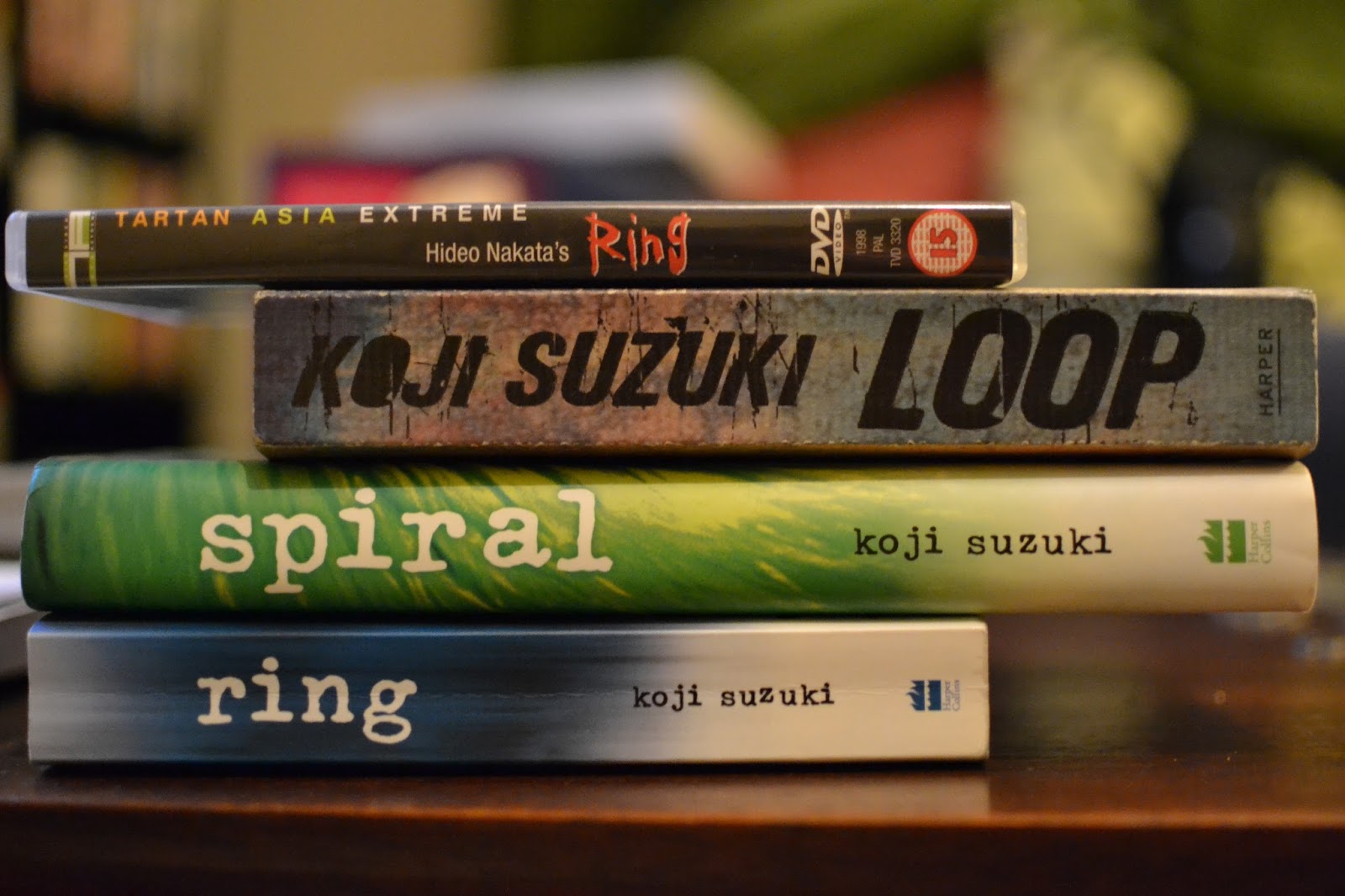
Ring/Spiral/Loop (Koji Suzuki)

Recently, there's been a lot of talk among the film festival circuit of Hideo Nakata's new release 'Ghost Theatre', after years of not really being talked about. Completely coincidentally, I decided to re-read the 'Ringu' trilogy (well, re-read two-thirds; read for the first time one-third) that inspired the film that shot not only him, but many other 'Asia Extreme' directors to international fame.


'Ring' is an interesting one in the 'book vs. film debate,' with the majority of people typically claiming the book is better to give the vain veneer of being mildly intellectual (larks!). For me the film overshadows the book that gave birth to it. Nakata changed certain elements for the film version: changing the lead to a female, stating that females are more believable in being frightened; the very cinematic ending, that probably wouldn't have worked in book form. These changes improve Koji Suzuki's story, removing some of the stranger elements towards the first book's conclusion that spawn into the sequels.

'Ring', the first book in the trilogy is by far the strongest piece, starting with a detailed discovery by journalist Asakawa that his niece's mysterious and sudden death is linked to three others that happened at the exact same time. Investigating this lead, he visits the Villa Log Cabin where the four dead youths stayed a week before their deaths. There he finds a strange video that will change his life, for seven days, at least.

The idea and the story is a good one, and perhaps a 1990 satire on modern media leaving us all brain dead, who knows?! Enlisting the help of his friend, Ryuji, he searches for an answer to the 'charm' (it is continually referred to as) to lift the video's curse, and thus not die in seven day's time.

Much like the film, however, the two sequels are where things start to go wrong. 'Spiral' takes the theme to a new character, Ando, a doctor that carried out an autopsy on *spoiler-alert* Ryuiji's body. Ando, for some reason, seems to believe that Ryuji is trying to leave him a message in his DNA structure, using random code-breaking techniques from his college days to form a rather unlikely, and largely meaningless, message. This leads Ando to go through the same journey as Asakawa, only with less information, with DNA investigations, re-births and the 'virus' switching to book form following.

The third in the trilogy, that I hadn't previously read, 'Loop' gets even more far-fetched, with third main character, Kaoru, a student doctor, using some random thing he looked at as a child to try and solve the mystery of the new cancerous virus that is spreading across the world.   

I first read 'Ring' and 'Spiral' when I was a student, a good decade ago, when I was definitely less well-read. One problem of being slightly more well-read is that I have recently read 'Robin Ince's Bad Book Club', particularly the thrillers chapter. Ince's description of thrillers is that they are overly long, filled with unnecessary descriptions of clothing and naked breasts, designed more to just keep the reader amused rather than provoke thought. They are simply written, with everything explained, re-explained and again, to make a lengthy book to justify your buying it. All three of these books are long, particularly 'Loop', and - while this may be due to the translation - are quite simply written, particularly 'Loop'. 'Spiral' features an entire chapter that summarises 'Ring', and 'Loop' in turn has chapter dedicated to summarising 'Ring' and 'Spiral', as you go round-and-round - how possibly intentional?!

I enjoyed 'Ring', was less enthused by 'Spiral', and was just bored by 'Loop'. Things are just taken a bit too far here and it becomes a little over-indulgent. The 'Ringu' trilogy is about a video that spawned a book that lead to a major virus. The reality is that this was a book that spawned a film that spawned a DVD empire in the West, that lead to endless over-indulgent copy-cats, that quickly saw companies fold.

As with the first book, 'Ring', making copies only leads to problems, and turning a good book into a trilogy only serves to spoil the original. It should probably have just been left at that.

Ring
Days to read: 18
Days per book: 14.7

Spiral
Days to read: 14
Days per book: 14.7

Loop
Days to read: 15
Days per book: 14.7   

Wednesday, 21 October 2015

Fresh Dressed (BFI 59th London Film Festival)

Sacha Jenkins is a journalist I have heard of. I have two books that he co-wrote, in fact: one about hip hop; the other about racism. Both are hilarious. But there's more to Jenkins that cheap laughs, a mainstay of hip hop journalism in the Nineties, he is a man that can speak with authority about hip hop: old school, new school, true school, take you to school.

So, apparently there hasn't been a documentary made about hip hop fashion. Well, there has now. Attire has always been an important part of hip hop, from the olden days of early B' boys, to the designer brand-obsessed raps of the Nineties, to idiotically-dressed pop figures, such as Kanye West and Pharrell Williams. And this is where the film starts.

To start, I was confused. The opening credits, featured embedded interviews with West, Williams and Sean 'Puffy' Combs, of whatever he goes by these days. My expectations from the title and promotional literature I had perused suggested that this would largely be a film about the 'fresh' Eighties, with a 'where'd you get those?' outlook. Instead, I was seeing modern-day megastars discussing their definitions of 'fresh.'

But then things arrive where I was expecting them to be. Starting off with the days of slavery Jenkins does a quick tour of American history, most specifically African-American history, starting with the ideas of 'Sunday best', moving through various musical ages, before approaching the Seventies and the advent of hip hop, and more importantly, its style borne of gang culture. He then moves to the Eighties, and Dapper Dan's 'improved' Louis Vuitton styles that features heavily on many a classic rap album cover.


But then, as with hip hop, we go mainstream as we enter the Nineties, focusing on brands like Cross Colours and Karl Kani, as designers matched their styles to rappers, ensuring that every item they wore heavily featured their brand - something that rappers were only too happy to oblige with.

But things have moved very quickly here, and the vast majority of the film is interviews with designers, and the hip hop figures that have crossed-over into fashion. Business takes over, with discussions about how best to market your brand / oneself. Sean Combs becomes a central figure of the documentary, discussing his cross-over success, now more an entrepreneur than rapper.

This focus disappoints for me. I was much more expecting an exploration of kids' homemade styles, customising their gear to ensure they are fresher than fresh. Instead, this is more an exploration of a small section of the fashion industry, with lots of interviews with middle-aged business executives. It seems that, with the help of Executive Producer Nas, Jenkins makes the most of the interviews he got with some A-list names.


But this is Sacha Jenkins we're talking about here, and so all this business talk is put into a context. Combs, with Sean John, has been a success in 'hip hop fashion', but it seems a lot of his success is due to dropping the hip hop associations. With its Nineties peak, hip hop dominated fashion, with rappers in ads everywhere and big name designers following rappers. Rappers, in turn, set up their own brands, most of which lived short lives. The major labels will always be there, but their association with hip hop was a temporary fad, with more conventional styles the new order of the day.

What starts as innocent Eighties 'freshness' moves to Nineties 'ghetto fabulous' to big money making. The times have changed, and with kids customising their gang colours, owning one's rivals clothes was a sign of conquering their turf. But now, kids get killed over coats of brands they can barely pronounce. Just like hip hop, creative innocence has been lost to the quest for money, making this a hip hop story through-and-through. Though maybe a little more of the old would have made this a little more fresh.


Tuesday, 20 October 2015

Stretch and Bobbito: Radio That Changed Lives (BFI 59th London Film Festival)

I'm pretty sure I've got a shoebox or two of endless minutes of recorded-off-the-radio hip hop from the Nineties. Sadly, growing up in Luton, I had to make do with Tim Westwood's 'Radio 1 Rap Show' every Friday night at 11-2AM and every Saturday, 9-midnight. The Friday night show was usually better. Every week, I would record all six hours, sometimes adding some minutes from Big Ted and Shortee Bltiz' show on Kiss FM. I would then edit them down, eliminating what I already had or what Lil' Kim had ruined. This was pretty much my life circa '98-'01.

If, however, you were (un)lucky enough to have grown up in New York throughout the Nineties, you would have been able to do the same thing, though to the selections of the much better 'Stretch Armstrong and Bobbito Show'. If you were one of them there rappers with any ounce of skill, you would probably have made your way on to their college broadcast show every Thursday; a show from which the titular pair made little to negative money, but created a lifetime of memories.


Now, in 2015, with the twenty-fifth anniversary of their first broadcast together a week away, or something, Bobbito Garcia has trawled the archives of the video and tape recordings of the show to tell the story of the 'greatest radio show of all time' according to someone.

With a documentary such as this, you don't need too much of a story around it: all you need is some interviews with some people involved and the music will speak for itself. This was the approach for 'The Art of Rap' and is Garcia's approach here. Though there is some contextualising.

To start, we are introduced to the two men themselves: Adrian 'Stretch Armstrong' Bartos and Robert 'Bobbito' Garcia, with interviews with their parents, photos of their school days and some brief storytelling as to how they both found hip hop and in turn each other. Then, they decided to make a college radio show together.

What then follows is about an hour of the duo interviewing various hip hop heads that appeared on the show, all with an accompanying walkman to play the classic freestyles they once said about two decades ago. The likes of Jay-Z, Nas, Eminem, Raekwon, Redman, as well as people you've heard of, all take time to listen to the memories and wax lyrical about just how important the show was for MCs in launching their careers.

But, with a rap radio show only being as good as the rap music on offer, from 1996 onwards, with the decline in the quality of music felt by both, as well as criticism arising from their switch to Hot 97, the pair started a passive aggressive battle of wills, with the more beat-minded Stretch playing increasing ignorant raps to intentionally annoy the more lyrically-focused Bobbito. The show, therefore ended with the decline in hip hop, before a twentieth anniversary reunion show was made in 2010. So, with the twenty-fifth anniversary, they made a documentary.


Everything about this documentary is fun. This is two people doing what they do for the fun of it, loving every minute and barely earning a dollar for the privilege. This is reflected in the film, with both in good spirits throughout the interviews, showing the good rapport they had on the show, and with the hip hop elite.

The music speaks for itself, with endless clips of live freestyles from some of the best wordsmiths available, leaving the audience to HOLLLLLLLLERRRRRRRRRRRRRRRRRRRRRRRRRR!

This is probably one more for true heads, who will love it, but can provide an education for those less in the know. It brings back memories and will show you some things you may have missed. This is hip hop for the sheer joy of it and a reminder as to why we followed that path.