Showing posts with label Haruki Murakami. Show all posts

Monday, 18 February 2019

Burning (2018)


Recently watching Yukiko Mishima's"Dear Etranger" - where an everyday male is pushed to his limits, but rather than exploding violently, returns to a calm after a passive aggressive outburst - I was struck by the hero's choice to keep on the straight and narrow, rather than let that tension get the better of him. Based on the Haruki Murakami short "Barn Burning" (and also William Faulkner's story of the same name), "Peppermint Candy" director Lee Chang-dong chooses to let that tension out violently, allowing it to boil to an inevitable conclusion.


Adapting the character backgrounds, their interactions, however, are reasonably faithful to the original short. Jong-su (Yoo Ah-in) is somewhat of a lowly figure in Seoul. A farmer's son, he works low-level jobs while holding his ambition of becoming a writer. By chance he meets an old school friend from his farming village, Hae-mi (Jun Jong-seo) and the pair get chatting, meeting on several occasions before consummating their born-again friendship. But, having saved some money, she intends to travel to Africa, asking Jong-su to take care of her (non-existent) cat.

On her return, following an attack on the airport in Nairobi, Hae-mi returns, though not alone. Asking him to meet her at the airport, Jong-su is surprised to see her accompanied by the suave Ben (Steven Yeun); the trio then going for a meal together. Intrigued by his writing, Ben often accompanies Hae-mi whenever she meets up with Jong-su. Though feeling uneasy about being the third wheel and out-of-place among Ben's high society friends, Jong-su is also suspicious of Ben's wealth for one so young and mysterious about his earnings.


His father imprisoned for a violent outburst, Jong-su has to return to his family farm to tend to its needs. It is on the farm, after smoking some weed together, that Ben reveals to Jong-su his passion for burning greenhouses: ones simply asking to be burnt down. This only adds to the man's mystery. Indicating that he has found his next "victim" nearby to Jong-su's farm, Jong-su is obsessive in trying to figure out which it will be. After receiving a call from a distressed Hae-mi, she subsequently disappears, leaving him to obsessively pursue Ben in order to find answers to both Hae-mi's whereabouts and the puzzle of the next greenhouse.


The first thing to note about "Burning" is that it is long. At two-and-a-half hours with a slow pace, Lee allows a long of time for the suspense to rise, which he does well. Jong-su's life is coming to a low point: his dad in prison, taking over a failed farm and no clear career path or love life to speak of. Almost as if researching for a novel, he plots the possibilities for Ben's next barn attack, as well as staking out his home - this has become what he lives for. But the length doesn't drag too much; come the end, you are searching for numerous answers. "Burning", much like the Japanese short story, leads a lot of open ends and leaves it up to you to piece them together.


Ben is the anti-Jong-su: successful, confident and full of mystery. Steven Yeun plays him adeptly; his time in America giving him an aura of the foreign in Jong-su's world. His charm and seeming boredom at Hae-mi - the nature of their relationship unclear, as it is with his subsequent love interest - make Jong-su question what his exact motives are, fuelled by his story of burning greenhouses. Was this merely a stoned prank, or is there a much more sinister man lying beneath? He is fully under Jong-su's skin.


Ben is almost calling Jong-su to act. A man of mystery, he seems as if he doesn't even know himself, living the high life, but without any real purpose. As in his interview in Sight & Sound, Lee wanted to show the difficulties for today's youth in South Korea. Jong-su has nothing but intentions and feels unable to act on them; while Ben has everything but no sense of purpose. Jong-su's final act is the rage of the have-nots against the haves.

The ending may feel somewhat inevitable by the time it comes, but much like Jong-su's obsession, the longer you leave it and the more you mull it over, the more intriguing it gets. Having re-read the short after, as well as adding the ending, Lee adds a greater sense of mystery, obsession and social comment. What starts as a burning candle, explodes like a firework.

Tuesday, 16 January 2018

Every 14 Days...(41)


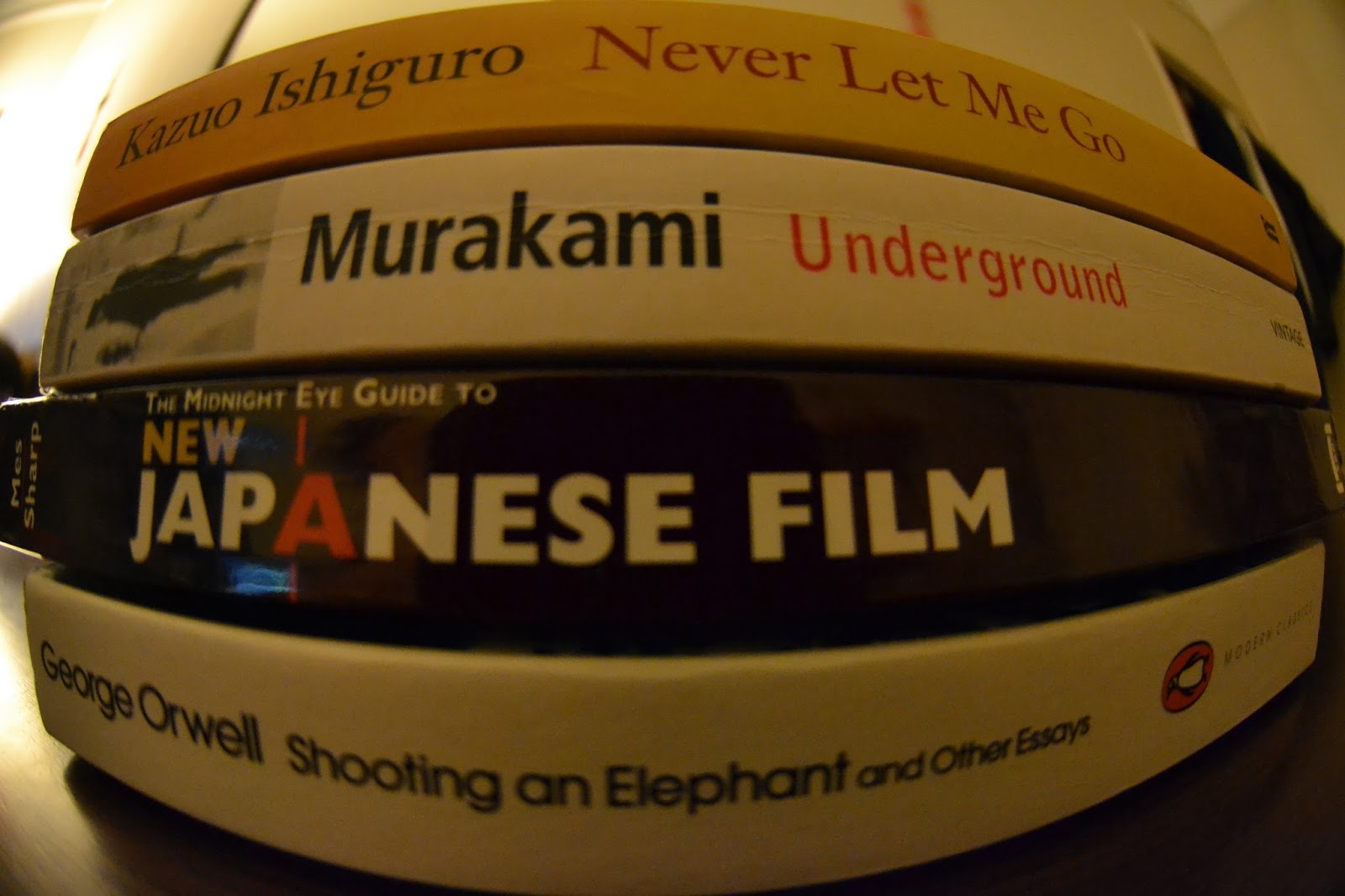
Never Let Me Go (Kazuo Ishiguro)

He's just won the Nobel Prize. Let's all go out and read his books. Of course, I already have...read two of his...the first two...set largely in Japan...because I'm like that.

As indicated, this is the third Ishiguro novel that I have now read, though where the first two worked for me, this one less so. 

Kathy is a carer reminiscing about her school days at the isolated and somewhat sinister Hailsham School. Now caring for her former class mates, we learn how her relationships with those she cares for developed.

With the children at the school asked to create works of art to be used in a sort of barter system - those standing out chosen for the mysterious "Gallery" - the children's intrigue creates tension in their relationships with the teaching staff. As the children grow older, they are able to learn more about their lives and their inevitable fate: Hailsham is a school for clones essentially bred for their organs, hence Kathy's role as a carer for her former classmates whom have already made their "donations."

There are interesting ideas about the nature of friendships between the three lead characters, as well as creating a sense of intrigue as to what the "Gallery" represents. However, when the element of the children bred as clones becomes clearer, the almost science fiction element loses me to an extent, just not really being my thing and removing a little of the book's intrigue.

The children coming to terms with their situation, being both human and not human, is where the strengths lie: sex simply recreational and something that the pupils just do; and forming a relationship a rumoured way to delay becoming a donor. But the context in which they are placed doesn't work for me - this is me being me, not speaking for others - and as such loses a bit of its soul...as well as a kidney or two.

Days to read: 15
Days per book: 15.1


Shooting an Elephant (George Orwell)

Having polished-off all of his novels, I thought I'd take a look at some of his essays. This collection, under the title "Shooting an Elephant" is a bit of a mixed-bag for me, though this is in a large part down to my own interest in the subject matter of each.

The titular essay is among the more interesting, referring to his days as a policeman in Burma and an obvious situation that arose; likewise "A Hanging". Indeed, the shorter works that show clear influence on - or parallel - what would become his novels and more detailed books are the best. "The Spike", "Looking Back on the Spanish Civil War" and "How the Poor Die" among these. Those looking at writing also are among the stronger efforts.

The longer essays, however, I found less engaging, largely because they are depth analyses of subjects of which I hold little interest - or at least pretend to show externally to appear a cool kid. The analyses of Charles Dickens, boys' weeklies and Gulliver's Travels are overly long and thorough for subjects I know little about.

But what do I know?!...I know the number I'm thinking of right now.

Days to read: 26
Days per book: 15.1


Underground (Haruki Murakami)

Judging by the bookmark I found sitting in it, I first read this when in Kyoto circa 2008. I was inspired to read it again after recently watching Kore-eda Hirokazu's "Distance" looking at the relatives of members of a fictional cult that orchestrated a terrorist attack on Tokyo. 

Looking at the Tokyo Gas Attack by Aum Shinrikyo of 1995, one thing I remember the first time around, perhaps confirmed this time also, was that the second half of the book - "The Place that was Promised" that features interviews with former Aum members - is the more intriguing. This perhaps goes against Murakami's original intentions to give a voice to the victims he felt ignored by the Japanese media, as well as perhaps being a little insensitive to the victims themselves interviewed in the opening chapters.

But, as with "Distance", looking at the motivations behind those that join such a cult is an unanswerable question often explored from the wrong angles. While interviewing the victims, he allows their version to flow; while with the former members, he is more challenging and questioning of their side.

As not an interviewer or sociologist, there is perhaps something a little lacking overall from "Underground" in drawing its conclusions. Though with the subject matter, this was never possible anyway.

I seem to remember once reading that "Underground" was all made-up. Though I probably made that up myself...

Days to read: 31
Days per book: 15.2


New Japanese Cinema (Tom Mes and Jasper Sharp)

This is a book I remember looking at in a shop about ten or eleven years ago. About ten or eleven years later, after much deliberation, I finally bought it. Reading this now, about thirteen years after its original publication, perhaps slightly downplays the "new" element of the title, looking in anticipation at the potential futures of new directorial talent to emerge along with Japanese cinema's temporary rebirth in the Nineties.

But given that a lot of the careers of the featured directors faded out after its publication, or international fame didn't particularly materialise, this does prove an interesting timepiece for the brief re-emergence of Japanese cinema on the international stage, covering many films probably still deserving of more international recognition two decades later.

I took my time over this one, quite unfortunately reserving this as something of a "toilet book": polish off a review while you polish off a...in some cases, yes. Though this does allow for time to do your own research and hunt down some of the films featured.

As previously mentioned, I probably read more about cinema than actually watching films these days; and of the ninety-seven (count them) films reviewed by Messrs Mes and Sharp I can now say that I have fully seen thirty-five (count them). Though interestingly, I have been more inspired to watch several films referenced, but not fully explored, by the pair. In that sense, delaying my reading of this book has been a nice way to discover some films, rediscover some others and perhaps encourage me to get round to watching some of the ones I probably should have by now.

In that sense the "new" is relative.

Days to read: 189
Days per book: 15.1

Monday, 24 July 2017

Every 14 Days...(38)


Men Without Women (Haruki Murakami)

It's fair to say that the books of Murakami (yes, that one) aren't quite what they were in his late Twentieth Century peak. While still somewhat enjoyable, there is a sense of a bit of simplistic repetition. So, where do these seven stories sit on the scale from creative enjoyment to more of the same?

Probably somewhere in the middle. His short story collections have switched between the very good to the quickly skipped over and forgotten, and while each of these entertain, the likelihood of any sticking particularly in the memory is slim.

The borrowed title for the collection perhaps reflects that fact in that they do not feel hugely original, and the theme of "men without women" is one he has explored before. But maybe I'm being harsh and these shorts stand up just as well as many of his previous works. You just feel that it needs a "Tony Takitani" or "The Wind-up Bird and Tuesday's Women" thrown into the mix to make it stand-out a little.

Days to read: 18
Days per book: 15.2


Mizoguchi and Japan (Mark le Fanu)

Now that I'm a dad and that, I probably read about more films than I actually watch. To this day, from memory, I have only seen "The Crucified Lovers" from Mizoguchi's extensive ninety-nine (such a frustrated cricketer) film oeuvre. But, given that many of these films were made pre-World War II, with many no longer surviving, not many - if any living - can claim to have seen all of his work.

Alongside Ozu and Kurosawa as one of the original masters of Japanese cinema, Mizoguchi has the claim that he got there first, his first film made in 1923, churning out dozens of now lost films in the Twenties and Thirties. While Kurosawa is known for his samurai epics and Ozu family dramas, Mizoguchi looked more at the lower ranks and underclass within Japan, and thus his works can be seen as a better reflection of the state of the nation in a period of widespread change.

Something of a feminist director, many of his films look at the lives of prostitutes and the struggles of women in Japanese society, something taken from the sacrifices his older sister made for his development. Le Fanu looks at his use of long takes and placing the camera at a distance to create a sense of realism, with the audience as voyeurs on the lives of the protagonists.

While not as well known today, Mizoguchi is one for the purists; his repeat success in Venice in the Fifties testament to this. Yes, I should definitely watch more Forties Japanese films about prostitutes...if only I had the time...I probably do have the time...I don't get out much...

Days to read: 15
Days per book: 15.2


Pachinko (Min Jin Lee)

"Pachinko" isn't a word that takes "Pa" (dad) and "chinko" (willy) to form a new, fun compound word, but rather combines "pachin" (snap or click) and "ko" (diminutive). The game is associated with a Zen-like repetitive motion within a world of sounds and flashing lights, but also Twentieth century Korean immigrant workers, as Min Jin Lee's book explores. Starting off in early Twentieth century small town Korea, it charts to journey of generations of an unorthodox family, as they cross the Sea of Japan to Osaka, suffering during World War II and subsequently building pachinko empires.

Now, books that chart generations of one family in a single novel can start to wear thin a little, feeling like brief history lessons, glossing over many areas, and lacking true depth. In some ways, "Pachinko" falls into some of these traps as the years develop, skipping to the Eighties quite quickly and abruptly, throwing in "of the time" generalisations, such as everyone having AIDS in the Eighties. Towards the end, the story tries to add too much, throwing in things suddenly in the hope of ensuring you're still awake, but overall taking away some of the good work done earlier in the book.

To start, young Sunja develops from naive country girl to strong woman as she is taken advantage of and escapes to Japan to avoid local scandal, before being forced to makes ends meet in the post-war years. All the while, the Korean yakuza associate who got her pregnant watching over her.

The social comment as to Koreans in Japan is an important one to explore, and to start, this is effective. But as the story develops, with new and varied characters thrown in, it starts to lose its depth and its way, with holes starting to appear, favouring somewhat extreme examples. As with many "epics," the interest can start to fade as breadth replaces depth.

Days to read: 21
Days per book: 15


Two Caravans (Marina Lewycka)

It's probably as interesting a time as any to read a book about Ukrainian migrant strawberry pickers. Not that the Ukraine are in the EU, but the Poles are, and some of them feature in this book. Written ten years ago, before Brexit was a thing, British-based middle-aged woman Marina Lewycka wrote "Two Caravans" about young immigrant workers in the UK, coming initially for seasonal strawberry picking.

As uncertainties today arise, the EU versus non-EU positions of the different nationalities is referred to frequently, written at a time when workers from Eastern Europe were on the increase. And I thought this would be an interesting time capsule piece to read from my wife's book shelf next to her Slash biography.

The problem with "Two Caravans", however, is perhaps a switching to guns, the criminal underworld and borderline white slavery. How much of this is true, I can neither confirm nor deny, but as a result, the look at the motivations, often naive, for coming to the UK feel a little watered-down by this. One can't help but feel what could have been an interesting look at migrant workers becomes a bit of a trashy novel in parts.

There are indeed interesting moments throughout, such as the "too many bloody foreigners" analysis of a middle-aged Pole. But trying to throw too much into one book has hindered its overall impact.

Days to read: 12
Days per book: 15.2

Saturday, 5 September 2015

Every 14 Days...(28)


The Bluest Eye (Toni Morrison)

My introduction to Toni Morrison's first novel, 'The Bluest Eye', was via the unlikely source of the liner notes of hip hop album. But hip hop ain't all ig'nant sheeeeet, with the more thoughtful 'Mos Def and Talib Kweli are Black Star' album featuring the track 'Thieves in the Night', with its hock borrowing heavily from one of the novel's closing passages.

I first read this as a suitably foolish twenty-one-year-old, largely in Newcastle's Heaton Park, and probably then I didn't quite grasp the power of the book. So now, reading it a decade later, did it register a little more?

The answer is yes. As a woman narrates, reminiscing on her childhood in 1940s America, the book explores race, the concept of beauty and the evils of modern communities when looking down on those they deem below them.

The story is fractured, splitting between the narrator's story, the past events that worked towards creating that time and a picture of an 'ideal' family. As the story continues, earlier passages become more powerful as their meaning becomes more and more clear.

Despite her own criticism of the work, it is elegantly written, reading with a flow that could inspire any hip hop, worth every moment of its second listen.

Days to read: 12
Days per book: 14.8


Robin Ince's Bad Book Club (Robin Ince)

When it comes to films, it's not the awful, 1-star films that should never have been made, it's those non-descript, neither good nor terrible, unmemorable, mind-numbingly average films that should never have been made. Most films starring Vince Vaughn, perhaps. If you know something isn't going to be a critical success, you may as well make it awful; it's more purposeful that way.

When it comes to books, in comes Robin Ince. Beautifully angry Ince had toured his 'Bad Book Club', reading aloud on stage from those books that should never been written - but deliciously, that is the very reason why they should exist. Setting himself the task of only reading books purchased second hand from charity shops and second hand bookshops while bored on tour for a price of under £3, this book - which category it fits in, you decide - is a summary of some of his favourite awful books.

Split into sections, Ince forces his way through biographies, Mills & Boon, thrillers, self-help guides, horror, religion, journalist collections and more, all finding themselves deemed necessarily awful. Quoting passages, there are moments of hysterics as you question why anyone would ever want to read it, or indeed ever sit down to write it.

So much terrible material can, of course, drag a little when reading, and there are moments when the reader can find themselves drifting in and out of concentration. Though you have to commend Ince's dedication to unearthing pure nuggets of fake gold descriptions of women's breasts, painful Syd Little anecdotes and the dietary requirements of Jesus. 

We'd all like to think that we're intelligent consumers of high art that many cannot understand, but there is something wonderful about the completely awful and what it tells us about humanity.

Toilet book? It certainly is full of shit.

Days to read: 18
Days per book: 14.8


Hear the Wind Sing / Pinball, 1973 (Haruki Murakami)

I'd already read all of Murakami's books, by which I mean, of course, I hadn't - I'd read all of his books that someone had bothered to translate into English. I'd seen academic English translations of his first two novellas, though being academic texts, they cost more than any student could afford, so I thought better of it.

But now, given his popularity in the West, someone has finally bothered to mass produce translated versions of his works he wrote while a Tokyo jazz bar owner - because no one really wants to read anything by a Japanese amateur unless they go on to have two and a half decade's worth of success.

So, what of these first two works by the young amateur? Well, not a huge amount really; very much what you'd expect from a young amateur. These are essentially two stories around the same characters at two points in time. Little really happens other than drinking in bars, buying records and playing pinball. You wouldn't be missing a great deal if these were never translated.

What you do get, however, is a sense of his style developing that he has maintained throughout his whole career. The characters are young - sometimes students - men unsure of their direction in life, spending their days in bars and beds, all to the accompaniment of specific music descriptions. The switching between narratives he most famously used in 'Kafka on the Shore' is also present in an early form.

Probably one (of two) more for the hardcore fans this. I can now actually say I have read all of his works, though I probably haven't learnt a great deal more as a result, apart from his introduction giving a little more detail as to why he first started writing: baseball is the answer we all knew it would be.

Hear the Wind Sing
Days to read: 6
Days per book: 14.8

Pinball, 1973
Days to read: 7
Days per book: 14.7

Tuesday, 30 December 2014

Every 14 Days...(24)


The Double (Fyodor Dostoyevsky)

Suppose I should read some Dostoyevsky in my life. Especially when it's two for £3.99.

With 'The Double' recently made into a film by Mr. Gadget Man himself, Richard Ayoade, I thought this would be a good place to start. Maybe it wasn't. The film met mixed reviews, as did the original story itself, even from the man himself.

A civil servant is one day shocked to find a 'double' of himself now working at his office, though the polar opposite to many of his negative traits. Soon, the 'original' finds himself behind his clone in work and social life, leading to a bitter conflict and an inevitable decent into madness.

The idea is a strong one, though the execution is maybe not always the best, not always a great read, though conveys the frustration, anger and madness that the 'double' creates in the story's hero. The humour in the writing is also good, with long-winded repeating of phrase. But towards the story's conclusions, you felt perhaps more could have been done with the idea.  

Days to read: 18
Days per book: 15.0


The Last Holiday (Gil Scott-Heron)

Gil Scott-Heron is a poet, and I know it. As one of the unofficial godfathers of rap, he is a master of words, and so I expect nothing less from his memoir. But as a memoir, this is a little confused. Released posthumously, it was always going to be more a sum of parts rather than a whole, and the supposed focus is not always apparent.

The idea was for it to focus around his part in Stevie Wonder's 'Hotter than July' tour in the early Eighties - a tour promoting Martin Luther King's birthday being made a national holiday - but before he could get there, he chose to tell the story of how he got to be there first. This results in the book essentially being an out-and-out autobiography up to a certain point in his life, but then sees several leaps in time over the next thirty years.

So, this may not necessarily be as it's billed, but this is jazz, baby. His writing doesn't need any structure, with his lists of adjectives flowing poetically off the page. There are indeed lots of poetry breaks throughout, almost as summations of the moment, like a haiku, but within the main body the words flow like a song.

This makes for a joyful read about his upbringing, his father who played or Celtic and the start of both his writing and music careers, edited and cobbled together for your listening pleasure.

Days to read: 19
Days per book: 15.0


The Strange Library (Haruki Murakami)

'The Strange Library' isn't really a new Murakami work, being that it dates from Japan in 1982, released as a short story of a different name. But it has now made its way to English translation, released as a illustrated children's book...which is probably why it was so quick for me to read, being that it is actually a book aimed at my reading level.

A young boy enters a library, returning some books, wanting to take out some more. He is sent to a strange reading room, where his reading of books is demanded by a strange old man, and of course, a sheep man - a Murakami favourite. Looked away and forced to read as much as possible about Ottoman Empire tax collecting, he worries that his mother will wonder why he has not returned home in time for dinner.

This book is less about its story, however, and more about the English translation which illustrates the story using images from The London Library and other collections. This make it more of a strange art piece than children's short story, making it interesting to look at, though the story flies by the images with ease.

Days to read: 1
Days per book: 14.9


Notes from Underground (Fyodor Dostoyevsky)

Yay! Hundredth book spectacular! So, it's just over four years since I started this pointless experiment. By now, I should have reached a little over one hundred books read. I'm a little off that target, having just reached one hundred exactly.

Not exactly a celebratory piece to mark the moment, 'Notes from underground' is a dark read about a middle-aged man, made bitter by the modern world, living underground providing us with a lecture as to the world's wrongs, before we are shown examples from his earlier life of experiences that led him to where he now resides.

The story is in two clear halves: the first a long, rambling critique of society; the second stories from his younger life. The first half proves a difficult read, with long rants in hard to digest chunks, though provides some interesting insights throughout. The book's second half is both an easier read and brings it back to life, as I felt myself often drifting into the depths of lost concentration in the first half. Here we see stories and characters brought in - and they are welcome - working as examples of the narrator's decent into the man he has now become, trapped in a St Petersburg basement.

This is an interesting read, an at-time-difficult read, but ultimately rewarding one, providing a criticism of early modernist society.

Here's to the next hundred...urgh...

Days to read: 13
Days per book: 14.9

Monday, 22 September 2014

Every 14 Days...(22)

Metamorphosis and Other Stories (Franz Kafka)


'Metamorphosis' is one of those famous stories that everyone knows of, but has it actually been read? Well, I hadn't read it. But now I have. Packaged with other shorts and musings, this is a mixed collection of writings, with, for me, moments of brilliance juxtaposed with moments less entertaining.

This collection starts with 'Contemplation', an interesting set of short moments that seem to link together in the life of the narrator, developing as they go along. 'The Rejection' is a good moment of comedy and works as one of the stronger works in this collection.

'Metamorphosis' itself is an interesting tale of changing, possibly inspired by Kafka's own burden on his family, and shows a sense of isolation that his change brings him. Wanting to still be part of his family and continue as normal, despite his now being a different creature, Gregor Samsa is instead shut away by his family as he has to come to terms with his new position in the changing family.

The other works here are mixed in the level of entertainment they gave me. Some are strong works, while others are ones that I simply did not get into and was quite happy to complete. Perhaps the timing of reading this didn't help having completed other short stories recently and characters and situations ever changing leading me to struggle to care for some.

The work is a classic and adds to the sense of Kafka's writing of change and man's struggle against systems that hold them.

Days to read: 17
Days per book: 15.2


Colourless Tsukuru Tazaki and his Years of Pilgrimage (Haruki Murakami)


You can say that I came to Murakami late, reading my first of his works, 'Dance, Dance, Dance', after most of what he's written had already been translated and released in English. Most of my reading of his books, therefore, has been playing catch-up, gradually making my way through them over a period of a few years.

Having made my way through all of them, 1Q84 was the first of his novels that I actually anticipated being released, and bought pretty much on the day of release, all three of them! And now his next, new, long-winded titled novel is one that I anticipated, pre-ordered and read, almost instantly. But whereas before I read his books for pure pleasure, now they arrive with the expectation to at least match what came before - something which rarely happens.

Character-wise, the man of the title is classic Murakami: a self-conscious single man, unsure of his place in the world, experiencing the odd sexual encounter here and there. Now approaching middle age, looking back on his teenage years and his tight-knit group of friends - all whose names feature a colour - the woman he is currently dating suggests he searches to discover why the group suddenly excluded him...if he wants some more nookie, anyway. With some quicker than lightning research, she locates the four other members of the high school group and thus starts his journey of discovery, or pilgrimage, if you will.

To start, I was quite disappointed. I'm not sure if it was due to other recent reads, but I initially found Philip Gabriel's translation just a little simplified, feeling like it was written by Dan Brown. While I've always liked how Murakami is an easy read, it made me wonder if increasing popularity brought with it a steady dumbing-down of content. But sticking with it, this became less noticeable as the book went on, and it flowed nicely.

It's fair to say that this isn't his best book, probably not even up there among his best. Despite the anticipation, it's a solid effort, like the ones read casually on holiday while working my way through his bibliography. Perhaps it's best just to read  as you find it, skipping the anticipation part altogether. Though this one did come with some 'adult' stickers, which made me feel very grown up. And no doubt, I'll be pre-ordering my copy of 'The Strange Library' when released later this year...I never learn.

Days to read: 16
Days per book: 15.2


Japanese Rules (Sebastian Moffett)


This is a book written to be read by me. Let's just look at the full title in a little more detail: 'Japanese Rules (oooh, Japanese): Why the Japanese needed football (oooh, football) and how they got it (oooh, sociological)'. Bought for me by my fiancée as a birthday present (awwww), I almost immediately started reading this and was 'into it' from the kick-off (a football-based joke there).

While it goes back a little further to set a context, the book focuses on 1993-2002, perhaps the most important ten years in Japanese football's history, or indeed, Japanese history (that's a socio-political joke). With the advent of the J-League in 1993, bringing with it the likes of world renowned toe enthusiast Gary Linekar, Sebastian Moffett charts the rise, fall and subsequent rise of the beautiful game in the Land of the Rising Sun.

But more than just a chronological piece about which fading stars arrived to end their careers on a big pay-day as the MLS now does (it does do this), it tries - as my Masters dissertation failed - to explore how football in Japan was a sign of social change in the country, representing a new Japan ready for the new millennium...and hosting a World Cup.

Football teams were small, and far behind that if baseball in terms of popularity and funds in the 'bubble period' of Japan. The one thing they had in common, however, was that teams were company-owned, taking their names and made up of 'amateur' players masquerading as kaishain, or company employees. Loyalty was to the company, and you did as you were told. With the advent of the J-League in 1993, the premise was a move away from the post-war Japan of loyalty to the company, wanting teams to be named after their locale, supporting their fan bases and having fans show a wild side.

The big name signings, endless company money piled into the League and novelty saw large attendances to start and fans bases built. But in a culture of not questioning superiors, uniformity and following procedures, football didn't really work. Foreign players and coaches alike found team mates unable to make quick, spare-of-the-moment decisions or think for themselves in a sport that loves individual style and flare. The lack of any successful national team saw football's popularity gradually decline, as foreign players and coaches alike struggled to gain any real success.

But 1998 and World Cup qualification in France, alongside a previously unthinkable co-hosting with South Korea planned for 2002, saw something to shout about, and with more teams formed, more experience gained and greater football professionalism, fan bases became established and club identities formed, culminating in Nakata Hidetoshi dyeing his hair.

Football fandom was something new to Japan: being individual, loud and brash, doing outrageous things in public - largely getting naked. Foreign influenced was large, shown in team names and fan styles, with unique atmospheres created, as I have experienced myself. Like football in Japan, this isn't the greatest book ever written, but I love it in my own unique way.

C'mon Verdy!

Days to read: 13
Days per book: 15.1

Tuesday, 11 December 2012

Every 14 Days...(14)

The Beautiful and the Grotesque (Akutagawa Ryunosuke)

Japanese literary legend Akutagawa is a writer I’ve come across more from film adaptations than actually reading his work. I have polished off a few of his shorts (boom boom) in the past, most notably ‘Rashomon’ and ‘In a Grove’, but with ‘The Beautiful and the Grotesque’ I have more than doubled the number of his works that I have consumed.

A mix of weird and wonderful, the collection is started by a rather intriguing, if not overly long and bemusing, introduction by translator, John McVittie, which sets the collection in  a strange context. Typically well written, the collection is full of interesting life lessons in short story format that chiefly inform, educate and entertain.

But while each story has its own place, reading endless back-to-back new stories can leave some flying passed with barely a word being taken in. while some show why so much has been put on his talents, others I can barely remember, and so may have to be read another day…if I can be arsed.

Days to read: 22
Days per book: 14.3


Blind Willow, Sleeping Woman (Murakami Haruki)

From one legend of Japanese writing to a more modern day equivalent – though not so much in his motherland. And another long collection of short stories – will I ever learn?! With an introduction by the author himself, the collection is both old and new, with some of his very first short stories previously unreleased in English combined with some newer works.

Like in previous anthologies of his that I’d read, some of the shorts were turned into full novels and so some of what was read was familiar, and the inclusion of ‘Tony Takitani’, made into an excellent film, I was often aware of the end results.

The stories here all have something in common: being rather strange. As with much of his work, there has to be a sense of accepting the incredible and once that’s done, they can be enjoyed. There are hits and misses here, but overall entertaining.

This now marks my completion of all Murakami’s work translated into English and available in the UK, so someone needs to either translate his earlier stuff of he needs to write some more.

It was also while reading this book that my ‘Every 14 Days’ experiment shot to fame via Richard Herring’s ‘Warming Up’ blog. Read here and listen there. 50 books read in 716 days, falling just short of my target two years in to this failed experiment and counting…

Days to read: 16
Days per book: 14.3


I Can Make You Hate (Charlie Brooker)

The latest in the line of the father Konnie Huq’s son’s columns from ‘The Guardian’ and more of the same. With the death of his ‘Screen Burn’ column part way through the time period, some scripts from his television shows have been thrown in for fun. However, as these are items done using cutaways and video clips, they are not always as effective in print and so could have been left out at little detriment to the overall collection.

The removal of ‘Screen Burn’ means that there are less ‘Big Brother’ obsessed moments and more of a range of topics to entertain while your anus is expanded as you evacuate your bowels.

Days to read: 11
Days per book: 14.2


Back Story (David Mitchell)

Sex, drugs and rock n roll. This is neither the time nor the place.

It’s fair to say that David Mitchell hasn’t exactly lived a wild and crazy existence up until now. Despite obviously having the interesting aspect of a career in television comedy to comment on, his life outside of work could be described as quite unremarkable: He went to a minor public school, then was chairman of Footlights at Cambridge before taking the leap to work low level jobs in London while trying to fulfil the ambition of a career in the media that many fail to achieve.

While he’d certainly be the most interesting of your friends and one to definitely include on the invites to a dinner party, he has little of a love life in which to speak of and the only real scandal surrounding him is that he isn’t as similar to Mark Corrigan in real life as one might have originally thought. And that’s what makes this a more interesting autobiography than many.

Keeping in line with a lack of any shocking life events of which to speak, the memoir is based around the fact that after suffering from a bad back, he was encouraged to take walks to improve his physical state. Staring off in his home in Kilburn, Mitchell makes his way through the London streets, ending at Television Centre, Wood Green. Along the journey, various landmarks recall a chronological account of the various stages of his life. Maybe not completely original in chronological and metaphorical recounting, but nice nonetheless.

What it lacks in shock value it makes up for in pure pedantry in his trademark logical manner. It’s an honest account – particularly regarding his recent engagement – and provides insight into his opinions on how television works and why most of it is lacking. And if reading at Waterloo Station, a fat woman might say ‘good choice’ to you.

Days to read: 19
Days per book: 14.3

Thursday, 5 January 2012

Every 14 Days...(7)

Talking Cock (Richard Herring)

‘Hello, I’m a spitting penis…’ No, that’s not how this book reads. Nor did I read the hardback edition. Oh, the endless cock-based puns. Thankfully, ‘Talking Cock’ isn’t 296 pages of knob gags. The first 50 or so pages are, but beyond that it gets relatively more serious…sort of.

A result of his stand-up (ho ho) show of the same name which was a male answer to the ‘Vagina Monologues’, ‘Talking Cock’ is my favourite talking cock, Richard Herring’s, first book. Presenting the findings of his large cock (ho ho) survey, this is a semi (ho ho) academic look at all aspects of the phallus, from circumcision to the Prince Albert. Some of the thousands of responses given in the survey are quite alarming, as well as downright funny, such as the man who inserted his penis into a toilet roll spoon-filled with jelly; making the poor sap that inserted his into a jelly-less toilet roll seem quite unadventurous.  

Reading mainly on public transport, made this quite an embarrassing read, with little cocks drawn in the corner of each page, as well as huge wangs popping up (ho ho) here and there. Thankfully, this is more than just a crap, novelty humour book, and can stand up (ho ho again) as a good read all on its own.

Days to read: 12
Days per book: 16


1Q84: Books I, II and III (Murakami Haruki)

Murakami’s latest work to arrive in English is a three-part epic set in the Orwellian year of the title. At around a thousand pages combined, it is not the easiest of reads, telling the story through two, and later three, characters in alternate chapters.

The plot(s) thus: to start, we are introduced to the story of Aomame, a female assassin, hired to kill paedophiles and wife-beaters by a rich, aging woman, that she is also a personal trainer for; seemingly unconnected, the parallel story is that of Tengo, a Maths teacher and ghost-writer, asked to re-write an intriguing novel by an unusual 17 year old girl. As the book progresses, gradually the two stories converge into one as the connections between the two become more and more clear.

Two things become clear early on: a) this resembles two of Murakami’s best works in ‘Kafka on the Shore’ (parallel stories and converging) and ‘Wind-up Bird Chronicle’ (dividing the book into three parts); and b) this is a long book that maybe doesn’t need to be quite so. While the story is good and initially very intriguing, he has done similar books previously and better. 1Q84 is a book that requires a lot of effort, but is not as rewarding as some of his other works. The writing style doesn’t flow as well as in his other works either, more so in Book III, translated by Philip Gabriel rather than Jay Rubin, where there is a lot of repetition within the text.

This is, however, still a worthy edition to his oeuvre; it just doesn’t need to feel like it took twenty-eight years to read.

Book I
Days to read: 21
Days per book: 16.2

Book II
Days to read: 22
Days per book: 16.4

Book III
Days to read: 13
Days per book: 16.3


It’s been just over a year (26/11/10) since I began this failed experiment, attempting to read a book every two weeks. So far, I should have completed 29 books, though currently I am resting on 25 since beginning, taking just over two extra days on average to complete a book than my target. With 2012 providing new promises of Olympic failure, I hope to rein in those two extra days over the next twelve months…Next up, Spot the Dog and the Mr Men Collection.

Thursday, 3 November 2011

Every 14 Days...(6)

Kappa (Akutagawa Ryunosuke)

On reading alone, ‘Kappa’ would seem like a book written by a man at the point of madness. A man is thrown into the ‘kappa world’ to live among these strange, mythical creatures from Japanese folklore, gradually learning their idiosyncrasies and customs.

Akutagawa Ryunosuke was at the point of madness when writing one of his longer works; finished not long before his suicide. On writing about the kappa world, he looks at all aspects of life: politics, religion, love, war, law, entertainment, health, etc., serving as a critique from an outsider’s perspective. Obviously doubling as a critique of the Japan in which he lived and how customs often get in the way of logic and sense to an onlooker.

Akutagawa himself was marginalised at this stage, being in and out of psychiatric hospitals, and so chose to look at society for what it was from a distance; and saw madness in the method.

Days to read: 12
Days per book: 15.3


The Japanization of Modernity: Murakami Haruki between Japan and the United States (Rebecca Suter)

This is a book written in English by an American about a Japanese author that I bought in Hong Kong. Read coincidentally to coincide with the UK release of his new work ‘1Q84’, Suter’s work is essentially a PhD look at his work across cultures in both Japan and the US.

Mainly looking into his shorts (ho ho), the differing reception of his work in the US and Japan is compared, with more traditional critics in Japan believing his works are not Japanese in style or content. Western critics, however, are more praising of his work and his look into identity from a global perspective.

Indeed, Suter believes that Murakami’s use of Western reference points in a Japanese setting give him a global appeal that is both normal and exotic at the same time. A timely conclusion with his latest offering creating midnight openings on its release.

Days to read: 39
Days per book: 16.5


I, Partridge: We Need to Talk About Alan (Alan Partridge*)

‘A real corker!’ (Toby Anstis)

With every Tom, Dick and Harry feeling the need to tell us about their – quite frankly pitiful – lives, I thought it best that I, Alan Partridge, set the world to rights with my follow up to the Loddon Eye Best Seller, ‘Bouncing Back’.

Think of the book as thus: An all-out, balls-to-the-wall account of my life, career and the bits in between. Shooting from the hip and taking absolutely no prisoners, much of what was written was deemed ‘too hot’ by my original publishers, Penguin. ‘Goolies to that!’ was my uncompromising response. Harper Collins being a much more thorough company, I decided to take my work to them instead.

So, sit back, relax, grab a mug of Nestle’s Milo Nutritious Energy Drink, prepare a dictionary and thesaurus (it gets a little tricky in parts) and do not p-p-p-p-pick up a Penguin. Pick up a fantastic Harper Collins. But don’t take it from me, take it from mambo soul crooner, Lou Bega…

‘This is my mambo number 1!’ (Lou Bega)

*I would like to make it categorically clear that, contrary to controversial e-rumours on the world wide website, Steve Coogan, Armando Iannucci, Rob Gibbons and Neil Gibbons (whoever they are!) wrote not a jot of this mini-masterpiece. Every ruddy word was written by me, Alan Partridge.

Days to read: 11
Days per book: 16.2